
Vegetables
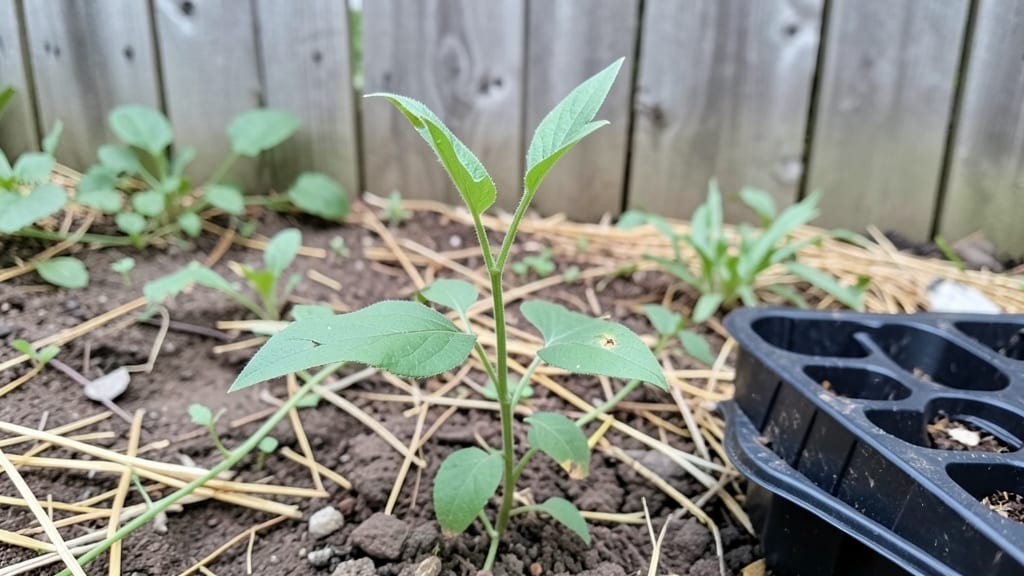
Identifying black bindweed seedlings early is critical because their heart-shaped leaves with pointed tips and glossy dark green color appear in dense clusters near soil cracks or disturbed areas. These aggressive growers spread rapidly through twining stems, making prompt removal essential to stop their invasive takeover.
Black bindweed seedlings can pop up almost overnight, especially in gardens or lawns that have been recently tilled or disturbed. 🌱 The key to stopping them lies in recognizing those distinctive heart-shaped leaves with their pointed lobes—these are far more pronounced than similar weeds like morning glory.
I’ve found that pulling them when they’re still small (under 3 inches) makes the job much easier, though you’ll need to dig deep to remove the entire root system.
What makes these seedlings particularly tricky is their ability to hide in plain sight until they’ve already established a stronghold. The twining stems can wrap around other plants, smothering them as they grow.
If you spot clusters of these glossy leaves near cracks or along garden edges, act fast—once they take root, they become nearly impossible to eradicate without persistent effort.
💡 In This Article
- Distinguishing Black Bindweed Seedlings from Common Weeds
- Best Early Removal Methods for Black Bindweed Seedlings
Distinguishing black bindweed seedlings from common weeds
The heart-shaped leaves of black bindweed seedlings are their most defining feature, but what sets them apart from lookalikes like morning glory or ground ivy is the sharp, pointed tip on each leaf lobe. These lobes typically form three distinct points, creating a triangular appearance when viewed from above.
Morning glory leaves, while also heart-shaped, have more rounded lobes that lack this pronounced pointedness, and their stems are less aggressive in their twining behavior.
Black bindweed seedlings also develop glossy, dark green leaves that appear almost waxy to the touch, a characteristic that helps them thrive in shaded areas. Morning glory leaves, by contrast, often have a slightly duller finish and may exhibit lighter green or even purple-tinged undersides.
Ground ivy (creeping charlie) leaves are more kidney-shaped with scalloped edges, and their stems grow low to the ground rather than climbing.
The growth pattern is another key differentiator. Black bindweed seedlings emerge in dense clusters near soil disturbances, often within just 7-10 days of germination. Their stems begin twining immediately, wrapping around nearby plants or garden structures with a clockwise rotation—a behavior that helps them climb and smother competitors.
Morning glory seedlings, while fast-growing, typically take 2-3 weeks to develop their signature trumpet-shaped flowers, giving black bindweed a head start in invasion.
Here's what to watch for when comparing:
- Leaf Shape: Black bindweed = heart-shaped with 3 sharp points; morning glory = rounded lobes; ground ivy = kidney-shaped with scallops
- Stem Behavior: Black bindweed = aggressive clockwise twining; morning glory = counterclockwise twining; ground ivy = creeping ground cover
- Growth Speed: Black bindweed = visible in 7-10 days; morning glory = 2-3 weeks to flowering stage
- Leaf Texture: Black bindweed = glossy/waxy; morning glory = slightly dull; ground ivy = matte
The most critical time for identification is when seedlings are 2-3 inches tall, before their roots establish deeply. At this stage, you can gently pull them by hand, but be prepared for resistance—their root systems are surprisingly strong for their size.
The key is catching them before they develop their signature 1-2 inch long aerial tubers, which store nutrients and allow regrowth if any root fragment remains in the soil.
What most gardeners don't realize is that black bindweed's twining stems can reach lengths of 10-15 feet in a single season, completely overtaking garden beds.
The plant's ability to photosynthesize through its stems (a trait called cladophyll) means it doesn't even need leaves to survive—making early identification absolutely critical. 💫